


I started the SEO MBA because I saw a skills gap. Not a technical skills gap but an executive skills gap. There were plenty of smart SEO professionals - people who could audit a site, debug javascript issues and crawl competitors. But I watched team after team being marginalized inside their organizations because they couldn’t communicate clearly and confidently in language that executives cared about.
That was the original reason for the SEO MBA: to help SEOs become business leaders.
But there’s a new skills gap in town: AI search.
Every industry has to reskill in the age of AI but perhaps none more so than search professionals. Not only is AI reshaping how work gets done, but it’s a radical rewriting of the rules of audience, distribution and web traffic.
The market already knows this. Kevin Indig and Amanda Johnson found that roles mentioning AI in the title paid 27% higher salaries; even mentions buried in the description carried a 25% lift. McKinsey found 44% of AI-powered search users now treat it as their primary source of insight, ahead of traditional search at 31%. And in one survey reported by Digiday, 87% of marketing chiefs said their board or CEO had asked them to build an AI search strategy, describing it as "an acute concern for execs."
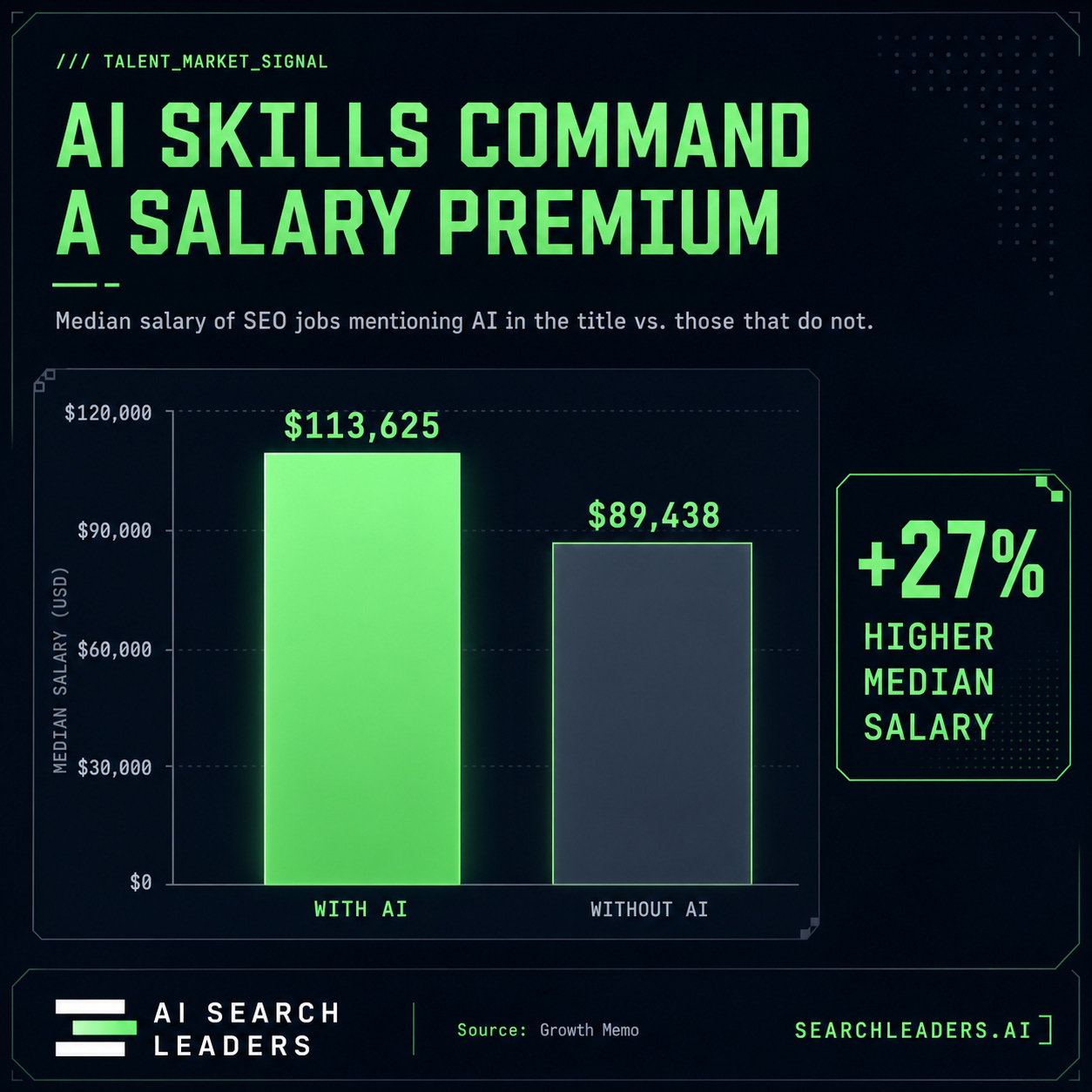
In short: executives are asking for AI search capability. The demand is there, the behavior has shifted and the market is already repricing the people who can make sense of it.
AI Search is Weird & Hard to Measure
Every business is circling the same questions:
How is consumer demand changing?
How do we measure success?
What is our visibility in the new world?
How do we allocate resources? What do we stop/start/shift because of AI?
How are ways of working changing?
How should our teams be structured now?
AI search is a strange beast. AI is reshaping the entire consumer demand and consumer behavior landscape but is also a difficult channel to measure.
Executives, boards and investors are asking for insights into AI search and the folks on the ground are forced to cobble together insights from a variety of 3rd party tools and data in wildly unsatisfying ways to try and infer some sense of the fundamental question “how are we doing?”
And that’s even before we get to the “...and what do I do about it?” part…
My working thesis is that AI search (GEO/AEO/whatever you call it) is not one thing - it’s a fragmenting discipline even more so than “classical” SEO ever was.
AI Search is Not One Thing
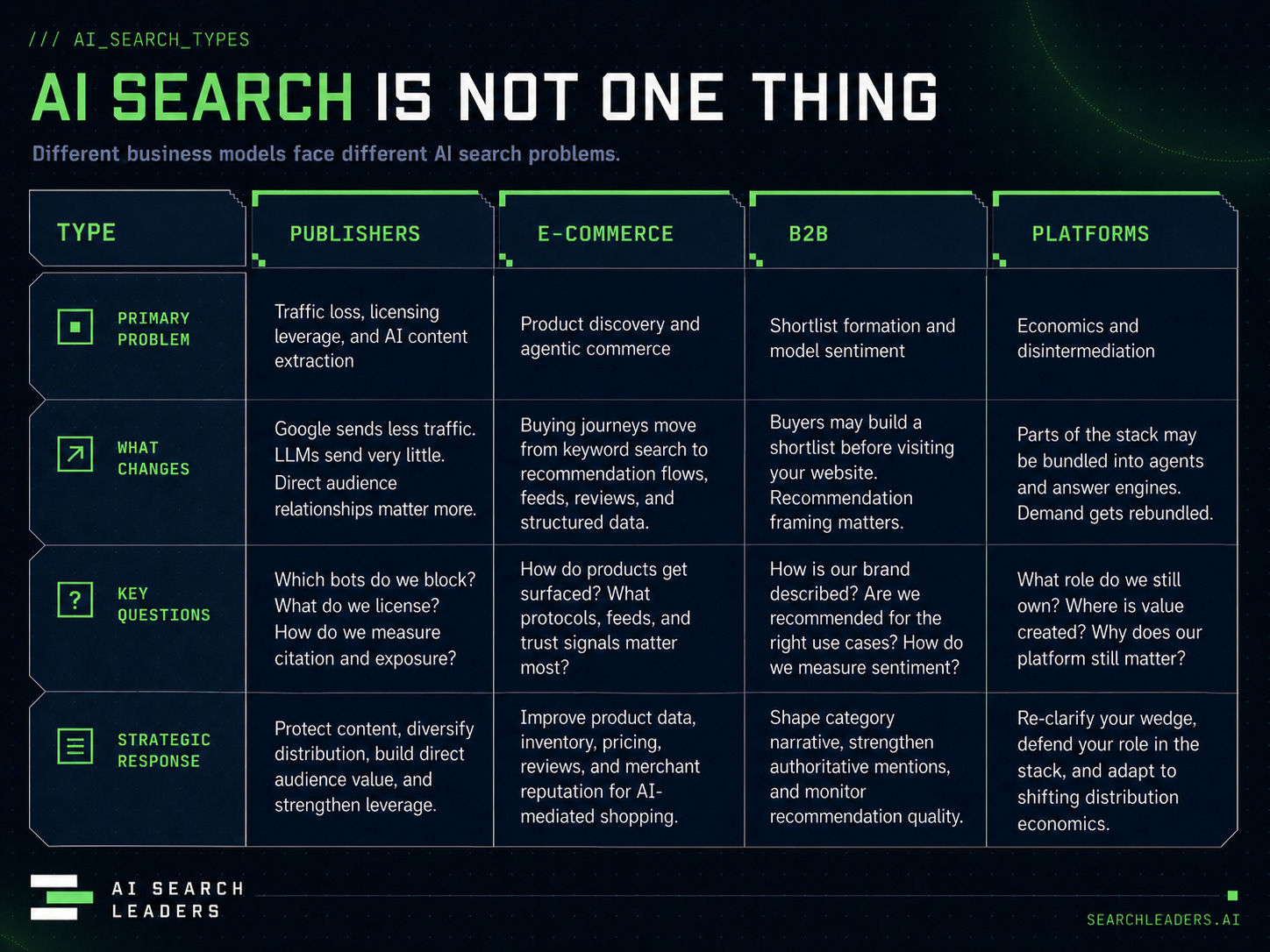
One of the laziest things we can do is talk about “AI search” as if it means the same thing for every business. It doesn’t.
For publishers, AI search is a traffic, licensing, and leverage problem. Which bots do you block? How do you enforce anti-scraping measures? What data do you need for licensing conversations? How do you build direct audience relationships when Google sends less traffic and LLMs send almost none?
For e-commerce companies, AI search is a product discovery and agentic commerce problem. Will Google’s Universal Commerce Protocol (UCP) win? Or will OpenAI’s Agentic Commerce Protocol (ACP) win? Or will WebMCP remove the need for either? How do product feeds, structured data, reviews, inventory, pricing, and merchant reputation change when software agents become part of the buying journey?
For B2B companies, AI search is a shortlist and sentiment problem. How do you make sure your brand is mentioned in the right contexts, described accurately, and recommended for the right use cases? It looks like self-promoting listicles have already hit a wall so how do you actually influence model sentiment and how do you measure it when everything changes every 3 months?
For platforms, AI search is an economics and disintermediation problem. If parts of the stack get bundled into agents and answer engines, what right does your platform have to exist? Where does demand get bundled, unbundled, and rebundled?
The job is changing
Meanwhile - if all of that wasn’t enough - the ways of working are also radically changing. The craft layer of SEO is being rebuilt in real time: rank tracking, crawling, content production, dashboards, reporting, research, QA, forecasting, internal tooling. Some of it will be automated. Some of it will be augmented. Some of it will become more important precisely because the machines make a mess.
No one knows right now what a “GEO” job description should be, or what “AI search” is as a discipline and I think there will be a fork in the road.
Some search professionals will move upstream. They will be in the room when executives talk about model visibility, customer behavior, brand preference, traffic risk, and capital allocation.
Others will get pushed downstream into production, reporting, and cleanup work that is increasingly automated or outsourced.
Same as it ever was.
The new skills gap
So what do search leaders need to learn?
First, new ways of working. SEO teams need to learn how to use AI tools without turning their content operations into a landfill. They need better QA systems, fluency in internal evals, better editorial controls, better internal tools, better review loops, and better ways of deciding what should be automated, what should be augmented, and what should remain human.
Second, new ways of understanding customer behavior. Prompt monitoring is just keyword tracking with a new coat of paint. We need to invent new ways of understanding brand awareness, sentiment, preference and influence through the LLM value chain. We need to grapple with the qualitative difference between being cited and being recommended.
Third, new ways of handling executive concerns. Senior search professionals need to answer harder questions. Not just “why did traffic go down?” but “how is demand changing?” Not just “what content should we publish?” but “what should the business stop, start, or shift because of AI?” Not just “where do we rank?” but “where are we trusted?”
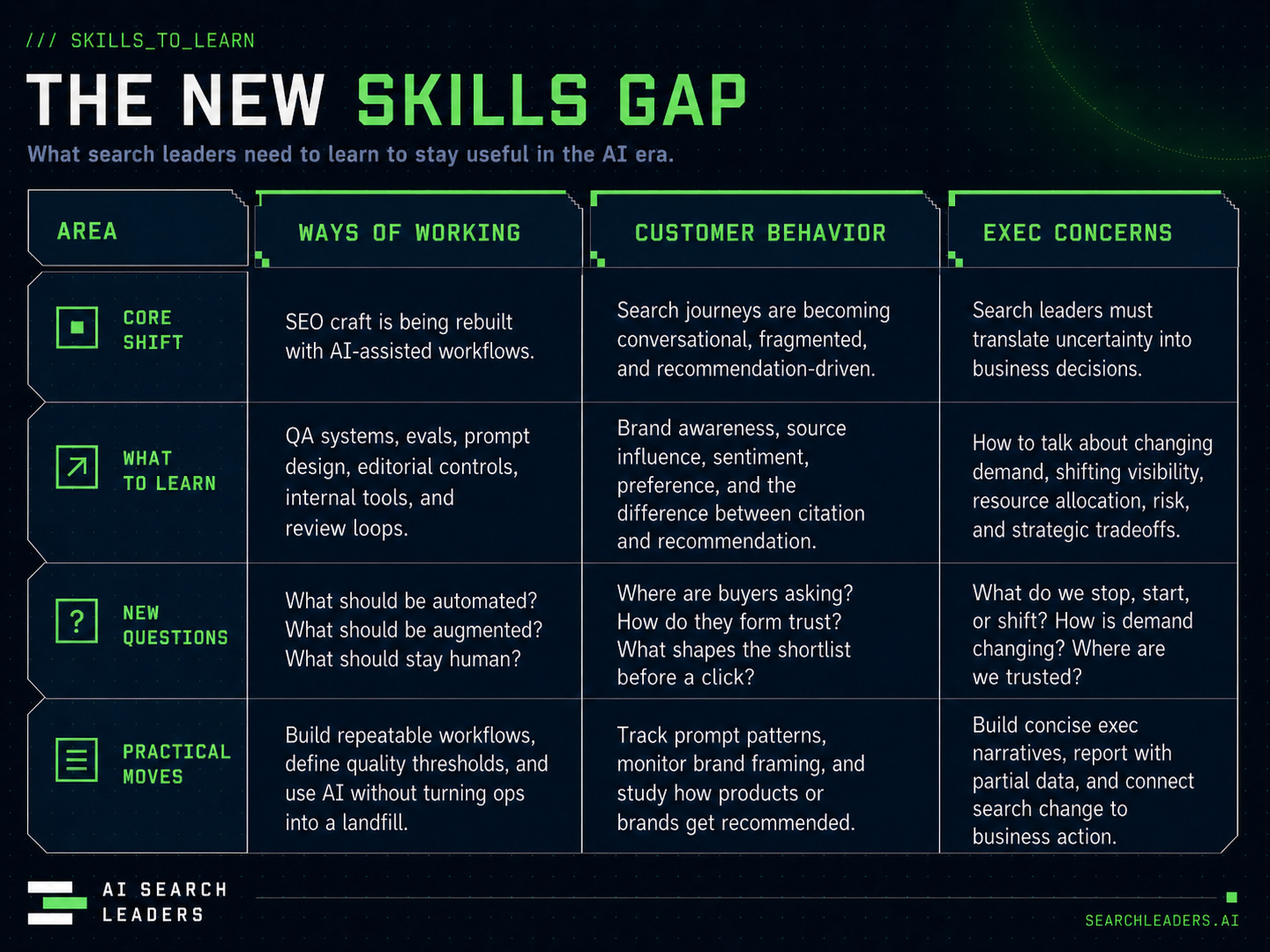
This skills gap is the same as it has been for a long time now - I believe SEO professionals that can combine technical fluency and executive fluency will thrive in this new era. It will be tough for those that can’t.
And no one has it figured out yet. The rules are still getting written.
Which is precisely why it needs a professional home.
Why I’m launching AI Search Leaders
This is why I’m launching AI Search Leaders.
I’m building it because I need it. The people I talk to need it. The questions are arriving faster than the answers, and the useful knowledge is scattered across private Slack threads, client calls, vendor demos, conference hallways, messy dashboards, and anxious executive meetings.
We need a place to compare notes in public enough to learn, but private enough to be honest.
And we all know there’s too much noise. We need a place for trusted, high signal conversations and knowledge sharing.
The SEO MBA was built around one belief: that SEO professionals needed to become better business leaders.
AI Search Leaders is built around the next version of that belief: that SEO professionals need a place to figure out the AI transition together at the level of business strategy.
AI Search Leaders is a membership and intelligence community for senior SEO professionals, audience leaders, growth leaders, consultants, and in-house operators navigating the shift from classic SEO to AI-shaped discovery.
Founding memberships are launching at $50/month for early members. Inside, we’re offering:
Bi-weekly expert sessions (coming up: Wil Reynolds, Mike King, Lily Ray, Aleyda Solis, Kevin Indig and more)
A peer group discussion space for candid discussion
Real case studies and wins that we can learn from
A library of resources including shared prompt library, how-to guides and more
The SEO industry has a skills gap again. Let’s close it together.
Join AI Search Leaders → https://www.searchleaders.ai/
